
Thursday, March 20, 2008

Reactrix to add transaction capabilities

As cool as a Reactrix setup looks while walking through a mall concourse or (increasingly) in movie theaters, I have to wonder whether their latest announcement -- namely, that they'd be adding the ability to conduct sales transactions via applications running on their network -- really made any sense. According to MediaPost,

Once a user is engaged with the experience, opportunities will naturally arise to offer promotions and actual sales of products from the brand advertiser, [CEO Mike Ribero] adds.

Ribero said commercial transactions could be handled one of two ways: through a credit-card swipe (or a wallet sensor for cards with Blink-style capability) or with new technology that ties mobile devices to credit cards, in which the consumer enters a confirmation code from the display.

It's one thing to say that people who interact with your virtual Honda salesroom (or whatever) will be able to remember the brand later. However, like those virtual shop windows that have been getting some buzz lately, this medium definitely seems more of an experiential experiment to me, and certainly not part of any "normal" purchase process that I'd be familiar with. That means Reactrix will have to convince a whole bunch of people that using their system is just another acceptable way of completing a transaction. They could be banking on the fact that younger generations are already (slowly!) getting used to the idea of using contactless systems and even their mobile phones as payment devices, and counting on this generation to look for more unique and gratifying ways to actually complete a purchase. For most people though, I don't see the demand or the advantage.

Tags: , ,

Friday, March 14, 2008

Japanese restaurant menus go high-tech

The Japanese have invented some pretty remarkable gadgets in the last couple of decades, but this one is just plain over-the-top. As reported at The Raw Feed, "Japan's TEC has created a restaurant table with a built-in 3-D LCD screen. The table, called the Tobidasu Menu, lets you browse food choices. The piece de resistance is that you can select each item on the touch-screen table for full-size, 3-D view. The table shows what your food will look like sitting in front of you."

According to one of the comments on that post, the Japanese are used to ordering food by appearance, and restaurants (even classy ones) frequently have pictures or even models of the food as well as a text description. Still, I have to believe that this kind of device is designed to be a novelty more than an actual ordering accessory, but I could be wrong.

Tags: ,

Thursday, March 13, 2008

Largest Hardee's franchisee tests self-service kiosks

According to QSR Magazine, Boddie-Noell Enterprises, the largest Hardee's franchise operator in the US, has begun testing self-service kiosks from provider EMN8 in three pilot locations. The pilot is intended to, "test the level of guest adoption of the technology, improvement in speed of customer service, and lift in average check the franchisee can achieve."
Hardees and others continue to test the devices for a number of purported reasons, including lifting the average ticket size (by using the kiosk to recognize and push up-sell and cross-sell opportunities), reduce average wait times during peak periods, and generally improve customer satisfaction. It's interesting, then, that none of the big guys have ever moved beyond the pilot phase, despite years of new initiatives. Maybe the cost of the implementation is too high. Maybe it requires too much ongoing maintenance. Or maybe it's too hard to educate the typical QSR patron about a new way of conducting a familiar transaction. But whatever the problem(s), it seems to be big enough to keep ordering kiosks from really taking off.

That having been said, these QSR chains keep trying new technologies and business partners, so it's clear that some of them really do want to see a viable ordering kiosk solution become available. Given the successes the airline industry have had with self-service, QSR does seem like the kind of environment that could really benefit from it. When and where that "eureka!" moment will finally happen, though, is still anyone's guess.

Tags: , ,

Friday, February 29, 2008

"Leap Day" causes problems for United check-in kiosks

And here I thought date/time calculations were pretty much a solved problem in the computer programming world. Apparently that's not the case.... at least, not if you have crappy programmers. This according to Chicago Business News, via the AP:
Passengers using United Airlines' "Easy Check-In" found it anything but that on Leap Day when the automated system failed, resulting in longer lines at its U.S. airport counters.

The Chicago-based carrier blamed the service interruption on software issues related to the leap year.

Spokeswoman Megan McCarthy says customers couldn't get Easy Check-In kiosks to confirm they had been checked in or print out their boarding passes for several hours.

McCarthy says no flights were delayed because of the problem. The airline apologized to customers for any inconvenience.
I'm sure that apology made the thousands of passengers waiting in line (after having been spoiled by the always prompt and courteous service of self check-in devices these past few years) feel much better. Makes you wonder how we did without the things just a few years ago :)

Tags: , ,

Friday, February 22, 2008

When to trade form for function

Ask any kiosk application designer to name his biggest challenges, and you'll see interface design high up on the list. It's not that it's technically difficult to build graphical applications, or that computers are too slow to show lots of visual bells and whistles. Instead, the true challenge lies with making an interface that is easiest enough for a novice to use, but powerful enough to get the job done, handle special cases, and deal with exceptions and errors gracefully.

Normally you don't hear too much about how an application performs after the fact, though these days we can use web analytics tools to figure out when people are exiting the process too soon, where they seem to get stuck, and which buttons they really like to press.

Sadly, the folks who deployed the self-service informational kiosks at Ballantyne Village in Charlotte, N.C. don't appear to have done this. In what might be the best kiosk user interface critiques I've seen on the web, user experience expert Lynn Marentette dissects an application and lets us come along for the ride thanks to the liberal use of a video camera and YouTube. Her ultimate conclusion:
The large interactive touch screen displays I found at Ballantyne Village didn't live up to potential, nor did they help me achieve my goals as a first-time visitor who happened to have some time and money for an after-work shopping session.

They displays were attractive, but they weren't very useful. They were difficult to use, and during the time I spent exploring the displays, I was the only person who interacted with the screens or noticed the other forms of digital signage in the area.

As I approached the first screen, I noticed that in order to activate the display, I had to chase a red ball around the screen. The migrating red ball attracted me to the screen, but it wasn't always functional. On the first display, as soon as I managed to touch the ball, the screen faded to red, and did not reactivate. I chased a ball on another screen, but it did not activate at all.

I was able activate another screen which allowed me to navigate and find more information. Unfortunately, the content wasn't well-organized or as interactive as I'd expected.

The display performed as if it wanted to be both a video infomercial AND an interactive website at the same time. Web-like navigation conventions, such as a back arrow and navigation bars did not always activate when touched. This might have been related to a screen calibration problem.

There were many on-screen items that were puzzling. There was a rotating map of a large view of the Ballantyne Village area that didn't seem to provide information when touched. There was another image of the main building, with small billboards displayed that looked like they were navigation tools, but did nothing when clicked. Some menu items activated when clicked, but the sub-menus that displayed did not link to anything. I never found out about the sales!
Just goes to show you (again) that what looks good on screen doesn't necessarily translate to a good user experience with your application.

Tags: , ,

Tuesday, February 19, 2008

Self-service kiosks 'ease airport experience'

That's according to Virgin Atlantic, who uses 220 check-in kiosks at 39 airports to handle check-ins for over 675,000 passengers per month. According to this article at Just The Flight:
The airline, which has introduced self-service check-in kiosks at all of its UK airports, has said that the options presented by the technology afford passengers a simpler airport experience.
"In the past [passengers] would have to go to the ticket desk and then onto a traditional desk to check in. Now they can do it all in one place, which obviously saves valuable time and gives the passenger a simple and seamless experience," said Janine Donovan, press officer for Virgin Atlantic.
According to the airline's website, as many as nine people can be checked in at once using the self-service kiosks, with a bag drop provided for passengers who have luggage to check in. (emphasis added)
Y'all already know I'm a big fan. But it's pretty cool to see a company with the style and panache of Virgin extolling the virtues of self-service as well.

Also getting in on the airport check-in kiosk lovefest is this article from USA Today about Alaska Airlines's kiosk network expansion. The company will ultimately utilize three clusters of 11 kiosks apiece and an additional 16 bag drop pods at Seattle-Tacoma airport. Along with the addition of kiosks, "the new lobby design has cut average check-in time by half, the airline says."

Tags: , ,

Tuesday, February 12, 2008

Wal-Mart to install Coinstar's '4th Wall' program

Progressive Grocer tells us that Wal-Mart will be installing Coinstar Centers, integrated self-service units that combine a number of interesting services, as part of their 4th wall optimization plan. The article notes:
The retailer will install Coinstar Centers, including the vendor's Redbox DVD rental kiosks, chain-wide over the next 12 to 18 months.In addition, as part of its 4 th Wall optimization plan, Coinstar will be removing or relocating certain entertainment products in Wal-Mart stores.

Redbox is currently installed in over 800 Wal-Mart stores, and Coinstar Centers (the vendor's coin-counting machines) are installed in over 400 Wal-Mart stores in the United States.

Coinstar's 4th Wall solutions include self-service coin counting, electronic payment solutions, entertainment services, money transfer, and self-service DVD rental, in addition to 4th Wall optimization consulting.
We had heard that some kiosk vendors were being asked to take out their devices, and others were being asked to update them. Rather than ditching self-service entirely as some had speculated (and seemed completely counter-intuitive to me), this 4th wall thing makes a lot more sense. Now customers will learn that all of the self-service devices are located in a single place in every Wal-Mart, and can modify their shopping behavior accordingly.

Tags: , , ,

Friday, February 08, 2008

Cyphermint to provide in-store shipping tech for Walgreens

I don't know if the systems are going to be customer-facing (and self-service) or just used by store personnel, but one thing I do know is that in-store shipping is becoming the new replacement for in-store photo development. Office supply companies like OfficeMax have offered in-store shipping service for a while now (and of course, the bigges like the UPS Store and FedEx/Kinkos have been making it the focal point for even longer), but DHL is definitely ratcheting up their presence by putting shipping points in 6,500 Walgreens locations across the US. From this press release:
Cyphermint designed a Windows based software solution which is the operating system for the DHL Shipping Spots. At Walgreens and OfficeMax retail locations, The DHL Shipping Spots are staffed by fully trained associates to weigh, label and ship customer packages to US and international destinations.

The user-friendly interface within the DHL Shipping Spots feature intuitive screen prompts which help retail associates quickly prepare a customer shipment. After the associate selects the destination, weighs the package, attaches the label and collects payment, the package is secured and available for DHL pick up. Associates working with customers that already have a DHL account can also enter the customer account number and have the remaining information auto-filled for their convenience. Cyphermint utilized the strengths and experience gained from the transactional and financial application of 7-Eleven's Vcom project and the customer service usability of the recent AAA kiosk to implement the functionality that was essential for the DHL Shipping Spot.
From the "user-friendly interface" comment, I had assumed that this might evolve into a customer-facing application, but after a second reading it's clearly geared towards being staff-assisted. Still, shipping packages seems like one of those things where a self-service solution could probably address 95% of customer needs. If these Shipping Spots prove to be popular, I wouldn't be surprised to see a self-service enabled version 2.0 roll out in the future.

Tags: , ,

Wednesday, January 30, 2008

Pay By Touch's "non-core" units on the block

I sort of wondered about whether Pay By Touch -- the biometric payment company that encourages shoppers to pay via fingerprint reader instead of swiping a credit card -- was making any money, and according to this article, apparently they're not (or at least not enough):
Biometric-authentication and loyalty-services technology provider Pay By Touch is in bankruptcy, has cut costs drastically, and is shopping some of its subsidiaries, but the company’s former chief executive--who is now a member of the firm’s newly constituted board of directors--says Pay By Touch is solid at its core.
Part of the problem is that the relatively young company tried to do too much too quickly, expanding into international markets and adjacent verticals like loyalty systems without first building its core US biometrics operations into a profitable entity. While the company is keeping some of its better performing subsidiaries like Capture Resource and S&H Greenpoints, everything else must go:
On the block are several so-called non-core subsidiaries operating under bankruptcy protection, including Paycheck Secure, ATM Direct, and Payment Solutions, the merchant processor that formerly operated as CardSystems Solutions Inc. Some observers were surprised that Paycheck Secure, which provides biometric-based paycheck-cashing services and came to Pay By Touch when the company bought rival BioPay LLC, is on the block. But Morris says Paycheck Secure serves convenience stores and other small businesses while Pay By Touch is focusing on larger retailers such as Shell Oil outlets and SuperValu Inc.’s Jewel/Osco supermarket-pharmacies. “We have not done that integration work” with Paycheck Secure, he says. “The core is viewed as being more around big, multilane retailers.”
I'd have to agree. If biometric payment is going to work anywhere, it'll be in those places where lines can be long and anything that will speed up the checkout process will be seen as a benefit to both retailer and consumer. However, given how quick and easy it is to swipe a card, and considering that cellphones and PDAs are increasingly being used as identification devices to allow access to personal (and personalized) services, I still have to wonder whether biometric payment systems will ever catch on.

Tags: , ,

Friday, January 25, 2008

Serious problems with Block Buster Express kiosks?

I just got through reading this blog post from John Bocook, a guy who went to check out a new Block Buster Express DVD rental kiosks at his local store, but came away with more than he bargained for:
The first ever Blockbuster Express Kiosk is located just down the street to me. I decided I would try it and see how it worked. I wish I had my camera. When I arrived to the kiosk the tech i guess forgot to unplug the Keyboard and mouse as they were laying on the floor. The computer guy in me decided to see what was under the hood. Two keys later i was looking at a Windows XP desktop with Admin privelages. How can it be? Blockbuster, Do you not realize what I could do if i was a ambitious hacker? If you don't let me tell you.
  • If Blockbuster isn’t careful, I could:
  • Despense DVD’s for free
  • Add a back door to get access to all the creditcard information that is swiped on this machine
  • Replace the “Play Trailer” videos with a more adult video of my choosing
  • Add a rootkit, so that even if the machine is re-imaged, I will will have a backdoor.
These are just SOME of the things we could do. How about we take the code for the Machine, figure out how the kiosk’s talk to each other and add a trojan to install rootkit on All the kiosks that connects to the main server hub. From there, We could say, Put in the name nich duncan under the account, and get free rentals at all the kiosks or get even more malicious and Swipe credit card information from ALL KIOKS (sic).
I have no idea whether these things are true, but given that we've seen lots of poorly-implemented retail kiosk systems in the past (indeed, for a while it was even thought that kiosks played a part in the largest theft of credit card data in history), and even electronic voting kiosks have been shown to have numerous vulnerabilities, I wouldn't be at all surprised if they were.

Tags: ,

Tuesday, January 22, 2008

The lowly vending machine reaches newfound heights...

... at least that was the conclusion drawn in this Business Week article about "luxury" vending machines and new devices that can dispense everything from hot soup to iPods and charge your credit card for the privilege. The article notes:
"The new luxury machines in the U.S. use a robotic arm to retrieve the products and are much more slick, high-tech, and interactive than the machines peddling soda and snacks. The gold-and-silver Coty machine in Queens Center, for example, has larger-than-life pictures of J.Lo and Becks plastered all over it. Instead of pushing buttons, shoppers use touchscreens to make their selections and get instructions on how to return purchases. A flat-panel TV continually plays a demonstration video with music.

"Certain machines have additional high-tech bells and whistles such as a 'virtual beauty consultant' at the Elizabeth Arden kiosk, which suggests the best product for a given skin type. The Coty machine lets customers sample the perfumes by pushing a button that releases a scented puff of air through a quarter-sized hole below a picture of the fragrance."
While numerous shoppers have indicated a preference for buying certain types of articles from a machine rather than a person, the article suggests that we're in fact witnessing a fad whose novelty may wear off. While I'll be surprised if machines selling plasma TVs or exotic lingerie will ever become commonplace, there's a tremendous convenience in being able to shop, buy, and instantly receive your product after hours or without being bothered by a bunch of salespeople. The high-end machines that carry these items bring the best of the Internet (easy shopping and operation at all-hours) together with an important bricks-and-mortar advantage: instant gratification.

Tags: , ,

Tuesday, January 15, 2008

Microsoft Develops Digital Kiosks For Grocery Stores

I know, I know, we've heard this kind of news bite several times before and it's always garnered mixed results at best. Yet, according to this article in AdWeek, Microsoft is obviously determined to provide a more interactive grocery store experience that is tied into shopping carts.

There is definitely reason to be skeptical with this kind of announcement, yet there is also reason to be at least partly optimistic. From a tech stand point, Microsoft is certainly a name to be trusted. If the right advertising and marketing know-how can get behind the kind of well-developed technology that Microsoft is capable of, then it could work.

Reading this article, and then looking back at articles about similar attempts, I got the same feeling that I had when I read Nielsen was going to try to put together a way to better measure digital signage/out-of-home ads. No matter how many attempts have been made at a promising idea and how badly they may have failed (which has certainly been the case with measurement systems), I feel it's worthwhile to look past those failures if an organization with a strong reputation shows up to tackle the issue.... Maybe I just haven't been working in this industry long enough :)

Microsoft is obviously putting a lot of stock into digital advertising because according to the article:
"While Microsoft has trailed large rivals like Google and Yahoo! in selling Web ads, it is moving to extend beyond the computer with its digital ad platform. It bought Massive, a provider of advertising on video game platforms. Last May, it bought ScreenTonic, a tech company that serves ads on mobile phones."
It's no secret that Microsoft isn't quite the dominating presence it once was (I'm sure they aren't hurting for money, but Apple, Google and Yahoo! are gaining strength) so if they can successfully move into the out-of-home digital ad realm and gain dominance before the others then it could be a pretty big victory.

With this, and the recent upfront announcement from NBC, it's obvious that very big names are circling this industry. So now it's just a matter of seeing which ones get things right...

Tags: , ,

Wednesday, January 09, 2008

Ez-Pic paperless coupon pilot raises some product sales by 71%

Not sure if this thing technically qualifies as a kiosk, but it's a pretty neat idea nonetheless (whether or not its time has come is a matter for further discussion, of course). According to this press release/blurb thingy from Progressive Grocer:
Big Y here grew sales of merchandise on promotion an average of 71 percent during a yearlong pilot of a new paperless in-store coupon system.

The solution, called Ez-Pic from Chicago-based Unicous Marketing Inc., is a paperless coupon advertised on retail store shelves and redeemed electronically at checkout. According to the vendor, data supplied for the study was made available by progressive Grocer parent The Nielson Co. and select manufacturers which used the Ez-Pic system in the pilot.

"Ez-Pic is a seamless value, with no aggravation for our customers," said Phil Schneider, v.p. of center store for Big Y. "Plus, there are no additional cost to us."

Unicous said Big Y benefitted through a higher volume of promotional sales and cost efficiencies related to reduced coupon handling time at checkout and on the back-end using traditional coupon clearing house processes.
I've been trying to find out more about the Ez-Pic system, but their homepage is a bit spammy and lacking information. I'm not too sure how it differs from simply having a sale price for the advertised product, as it's unclear whether the customer has to do anything (or not) to redeem the "electronic coupon" at checkout.

Tags: , ,

Tuesday, January 08, 2008

Self service check-in for international passengers at Mumbai airport news

If you've ever traveled through Mumbai airport, you probably know that just about any change is bound to be an improvement. And given the past successes of self-service in airports, I have high hopes for this project:
International passengers would soon avail themselves of boarding passes, be able to select seats and also check-in their luggage, with the help of 30 Common Use Self Service (CUSS) kiosks to be provided at the Chatrapati Shivaji International Airport by Mumbai International Airport Ltd (MIAL).

Passengers at New Delhi will, however, have to wait till March this year to be able to avail of the facility, according to a Delhi International Airport Limited (DIAL) spokesperson.

MIAL also plans to install 20 more CUSS kiosks in hotels close to the airport. "We are finalising the hotels where the service would be available," said an MIAL spokesperson.

The kiosks, to be installed by MIAL's GVK-led private consortia, will provide the option of paperless boarding, where a code will be sent to the flier's cell phone.

If well-implemented, that would actually be a step above any international check-in kiosks that I've come across yet, though I must admit I feel a certain amount of security in being able to clutch my paper ticket while moving through the throngs of people towards my gate.


Thursday, January 03, 2008

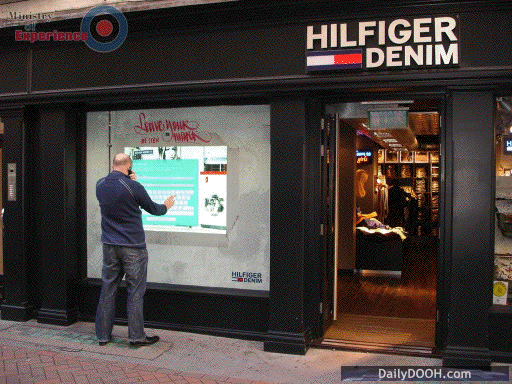
Hilfiger tries out interactive storefronts

Ralph Lauren's 5th Avenue Polo store made headlines last year when it debuted a system that let window shoppers interact with the store windows themselves via interactive touch screen and projection technologies.

Not to be outdone, Tommy has apparently joined the fray and is testing out some interactive storefront tech in Europe. According to a press release posted by fellow blogger Adrian Cotterill at the DailyDOOH:
Hilfiger stores in (London, Amsterdam, Cologne, Antwerp and Dublin) now feature unique through-window touch screen technology, providing an interface for passing shoppers to capture, stylise and submit their image as part of collage of images being shown on digital screens in the shop windows.

The digital storefronts enable customers to interact with the Hilfiger brand even outside of business hours. At the end of the campaign, customers will be able to return to the store and have their own T-shirt specially printed using the image they created as the design.

This is the first time a global fashion brand has embraced an interactive out-of-the-home format to create a unique channel for 24/7 dynamic relationship with its customers. The campaign also serves as mechanic for driving subscriptions to Hilfiger’s email newsletter, with users being asked to opt-in when uploading their images.
Obviously that last paragraph is incorrect, since the aforementioned Polo stores have been doing something very similar for over a year now. Still, there have been numerous sightings of one-off interactive storefronts across the globe now. One wonders if 2008 will bring a "standard" offering that retailers will be able to deploy universally and cost-effectively.

Tags: , ,