Wednesday, January 30, 2008

Pay By Touch's "non-core" units on the block

I sort of wondered about whether Pay By Touch -- the biometric payment company that encourages shoppers to pay via fingerprint reader instead of swiping a credit card -- was making any money, and according to this article, apparently they're not (or at least not enough):
Biometric-authentication and loyalty-services technology provider Pay By Touch is in bankruptcy, has cut costs drastically, and is shopping some of its subsidiaries, but the company’s former chief executive--who is now a member of the firm’s newly constituted board of directors--says Pay By Touch is solid at its core.
Part of the problem is that the relatively young company tried to do too much too quickly, expanding into international markets and adjacent verticals like loyalty systems without first building its core US biometrics operations into a profitable entity. While the company is keeping some of its better performing subsidiaries like Capture Resource and S&H Greenpoints, everything else must go:
On the block are several so-called non-core subsidiaries operating under bankruptcy protection, including Paycheck Secure, ATM Direct, and Payment Solutions, the merchant processor that formerly operated as CardSystems Solutions Inc. Some observers were surprised that Paycheck Secure, which provides biometric-based paycheck-cashing services and came to Pay By Touch when the company bought rival BioPay LLC, is on the block. But Morris says Paycheck Secure serves convenience stores and other small businesses while Pay By Touch is focusing on larger retailers such as Shell Oil outlets and SuperValu Inc.’s Jewel/Osco supermarket-pharmacies. “We have not done that integration work” with Paycheck Secure, he says. “The core is viewed as being more around big, multilane retailers.”
I'd have to agree. If biometric payment is going to work anywhere, it'll be in those places where lines can be long and anything that will speed up the checkout process will be seen as a benefit to both retailer and consumer. However, given how quick and easy it is to swipe a card, and considering that cellphones and PDAs are increasingly being used as identification devices to allow access to personal (and personalized) services, I still have to wonder whether biometric payment systems will ever catch on.

Tags: , ,

Friday, January 25, 2008

Serious problems with Block Buster Express kiosks?

I just got through reading this blog post from John Bocook, a guy who went to check out a new Block Buster Express DVD rental kiosks at his local store, but came away with more than he bargained for:
The first ever Blockbuster Express Kiosk is located just down the street to me. I decided I would try it and see how it worked. I wish I had my camera. When I arrived to the kiosk the tech i guess forgot to unplug the Keyboard and mouse as they were laying on the floor. The computer guy in me decided to see what was under the hood. Two keys later i was looking at a Windows XP desktop with Admin privelages. How can it be? Blockbuster, Do you not realize what I could do if i was a ambitious hacker? If you don't let me tell you.
  • If Blockbuster isn’t careful, I could:
  • Despense DVD’s for free
  • Add a back door to get access to all the creditcard information that is swiped on this machine
  • Replace the “Play Trailer” videos with a more adult video of my choosing
  • Add a rootkit, so that even if the machine is re-imaged, I will will have a backdoor.
These are just SOME of the things we could do. How about we take the code for the Machine, figure out how the kiosk’s talk to each other and add a trojan to install rootkit on All the kiosks that connects to the main server hub. From there, We could say, Put in the name nich duncan under the account, and get free rentals at all the kiosks or get even more malicious and Swipe credit card information from ALL KIOKS (sic).
I have no idea whether these things are true, but given that we've seen lots of poorly-implemented retail kiosk systems in the past (indeed, for a while it was even thought that kiosks played a part in the largest theft of credit card data in history), and even electronic voting kiosks have been shown to have numerous vulnerabilities, I wouldn't be at all surprised if they were.

Tags: ,

Tuesday, January 22, 2008

The lowly vending machine reaches newfound heights...

... at least that was the conclusion drawn in this Business Week article about "luxury" vending machines and new devices that can dispense everything from hot soup to iPods and charge your credit card for the privilege. The article notes:
"The new luxury machines in the U.S. use a robotic arm to retrieve the products and are much more slick, high-tech, and interactive than the machines peddling soda and snacks. The gold-and-silver Coty machine in Queens Center, for example, has larger-than-life pictures of J.Lo and Becks plastered all over it. Instead of pushing buttons, shoppers use touchscreens to make their selections and get instructions on how to return purchases. A flat-panel TV continually plays a demonstration video with music.

"Certain machines have additional high-tech bells and whistles such as a 'virtual beauty consultant' at the Elizabeth Arden kiosk, which suggests the best product for a given skin type. The Coty machine lets customers sample the perfumes by pushing a button that releases a scented puff of air through a quarter-sized hole below a picture of the fragrance."
While numerous shoppers have indicated a preference for buying certain types of articles from a machine rather than a person, the article suggests that we're in fact witnessing a fad whose novelty may wear off. While I'll be surprised if machines selling plasma TVs or exotic lingerie will ever become commonplace, there's a tremendous convenience in being able to shop, buy, and instantly receive your product after hours or without being bothered by a bunch of salespeople. The high-end machines that carry these items bring the best of the Internet (easy shopping and operation at all-hours) together with an important bricks-and-mortar advantage: instant gratification.

Tags: , ,

Tuesday, January 15, 2008

Microsoft Develops Digital Kiosks For Grocery Stores

I know, I know, we've heard this kind of news bite several times before and it's always garnered mixed results at best. Yet, according to this article in AdWeek, Microsoft is obviously determined to provide a more interactive grocery store experience that is tied into shopping carts.

There is definitely reason to be skeptical with this kind of announcement, yet there is also reason to be at least partly optimistic. From a tech stand point, Microsoft is certainly a name to be trusted. If the right advertising and marketing know-how can get behind the kind of well-developed technology that Microsoft is capable of, then it could work.

Reading this article, and then looking back at articles about similar attempts, I got the same feeling that I had when I read Nielsen was going to try to put together a way to better measure digital signage/out-of-home ads. No matter how many attempts have been made at a promising idea and how badly they may have failed (which has certainly been the case with measurement systems), I feel it's worthwhile to look past those failures if an organization with a strong reputation shows up to tackle the issue.... Maybe I just haven't been working in this industry long enough :)

Microsoft is obviously putting a lot of stock into digital advertising because according to the article:
"While Microsoft has trailed large rivals like Google and Yahoo! in selling Web ads, it is moving to extend beyond the computer with its digital ad platform. It bought Massive, a provider of advertising on video game platforms. Last May, it bought ScreenTonic, a tech company that serves ads on mobile phones."
It's no secret that Microsoft isn't quite the dominating presence it once was (I'm sure they aren't hurting for money, but Apple, Google and Yahoo! are gaining strength) so if they can successfully move into the out-of-home digital ad realm and gain dominance before the others then it could be a pretty big victory.

With this, and the recent upfront announcement from NBC, it's obvious that very big names are circling this industry. So now it's just a matter of seeing which ones get things right...

Tags: , ,

Wednesday, January 09, 2008

Ez-Pic paperless coupon pilot raises some product sales by 71%

Not sure if this thing technically qualifies as a kiosk, but it's a pretty neat idea nonetheless (whether or not its time has come is a matter for further discussion, of course). According to this press release/blurb thingy from Progressive Grocer:
Big Y here grew sales of merchandise on promotion an average of 71 percent during a yearlong pilot of a new paperless in-store coupon system.

The solution, called Ez-Pic from Chicago-based Unicous Marketing Inc., is a paperless coupon advertised on retail store shelves and redeemed electronically at checkout. According to the vendor, data supplied for the study was made available by progressive Grocer parent The Nielson Co. and select manufacturers which used the Ez-Pic system in the pilot.

"Ez-Pic is a seamless value, with no aggravation for our customers," said Phil Schneider, v.p. of center store for Big Y. "Plus, there are no additional cost to us."

Unicous said Big Y benefitted through a higher volume of promotional sales and cost efficiencies related to reduced coupon handling time at checkout and on the back-end using traditional coupon clearing house processes.
I've been trying to find out more about the Ez-Pic system, but their homepage is a bit spammy and lacking information. I'm not too sure how it differs from simply having a sale price for the advertised product, as it's unclear whether the customer has to do anything (or not) to redeem the "electronic coupon" at checkout.

Tags: , ,

Tuesday, January 08, 2008

Self service check-in for international passengers at Mumbai airport news

If you've ever traveled through Mumbai airport, you probably know that just about any change is bound to be an improvement. And given the past successes of self-service in airports, I have high hopes for this project:
International passengers would soon avail themselves of boarding passes, be able to select seats and also check-in their luggage, with the help of 30 Common Use Self Service (CUSS) kiosks to be provided at the Chatrapati Shivaji International Airport by Mumbai International Airport Ltd (MIAL).

Passengers at New Delhi will, however, have to wait till March this year to be able to avail of the facility, according to a Delhi International Airport Limited (DIAL) spokesperson.

MIAL also plans to install 20 more CUSS kiosks in hotels close to the airport. "We are finalising the hotels where the service would be available," said an MIAL spokesperson.

The kiosks, to be installed by MIAL's GVK-led private consortia, will provide the option of paperless boarding, where a code will be sent to the flier's cell phone.

If well-implemented, that would actually be a step above any international check-in kiosks that I've come across yet, though I must admit I feel a certain amount of security in being able to clutch my paper ticket while moving through the throngs of people towards my gate.


Thursday, January 03, 2008

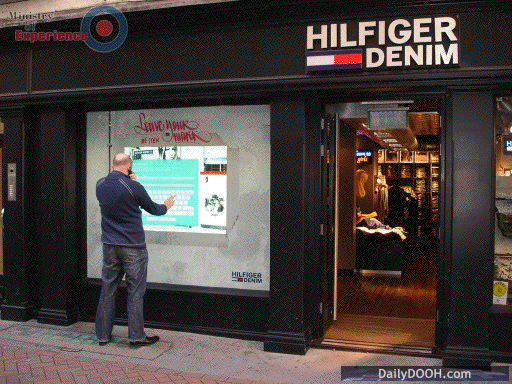
Hilfiger tries out interactive storefronts

Ralph Lauren's 5th Avenue Polo store made headlines last year when it debuted a system that let window shoppers interact with the store windows themselves via interactive touch screen and projection technologies.

Not to be outdone, Tommy has apparently joined the fray and is testing out some interactive storefront tech in Europe. According to a press release posted by fellow blogger Adrian Cotterill at the DailyDOOH:
Hilfiger stores in (London, Amsterdam, Cologne, Antwerp and Dublin) now feature unique through-window touch screen technology, providing an interface for passing shoppers to capture, stylise and submit their image as part of collage of images being shown on digital screens in the shop windows.

The digital storefronts enable customers to interact with the Hilfiger brand even outside of business hours. At the end of the campaign, customers will be able to return to the store and have their own T-shirt specially printed using the image they created as the design.

This is the first time a global fashion brand has embraced an interactive out-of-the-home format to create a unique channel for 24/7 dynamic relationship with its customers. The campaign also serves as mechanic for driving subscriptions to Hilfiger’s email newsletter, with users being asked to opt-in when uploading their images.
Obviously that last paragraph is incorrect, since the aforementioned Polo stores have been doing something very similar for over a year now. Still, there have been numerous sightings of one-off interactive storefronts across the globe now. One wonders if 2008 will bring a "standard" offering that retailers will be able to deploy universally and cost-effectively.

Tags: , ,

Monday, December 31, 2007

Florida tests out print-on-demand paper ballots

Well, we're about to enter a major election year, so why not roll out some brand-spanking-new voting technology to test on residents of the most notoriously voting-inept state in the whole union? At least, that must have been what Florida legislators were thinking when 27 counties decided to implement a new print-on-demand ballot system to create the optical scan ballots right as voters need them.

While the optical scan system is quite tried-and-true, the new machines will create ballots customized for a voter's particular party (useful in primaries where, in FL you're only allowed to vote for the party you're registered in). This is supposed to further decrease confusion and ballot clutter, which is good. Of course, as anybody who's ever worked on a big kiosk project knows, putting printers out in the real world = all sorts of problems including paper jams, misfeeds and the like. What happens to a paper ballot that has been slightly mis-printed when you run it through the optical scanner? What happens when a machine jams up? Will all polling stations have backup equipment? Will pollworker training be better than it was for e-voting initiatives in 2000 and 2004 (God I hope so)?

Aside from simplifying each voter's ballot, the major reason for implementing the print on demand system is actually cost reduction, according to this article in the St Petersberg Times. Apparently the heavy paper stock that the optical ballots require is rather expensive, so reducing waste ballots by only printing the exact number and type required will allow counties using the system to be more efficient (one legislator expected that they would have saved $45,000 and 600 staff hours had the system been in place for the 2006 elections).

Admittedly, anything that doesn't rely on Windows-based touch screen computers and lacking any kind of verifiable paper trail is going to be a big improvement over the 2004 Florida systems. Still, introducing complexity in a state where people couldn't tell the difference between "Left Side" and "Right Side" in 2000 isn't necessarily a good idea.

We'll get our first peek at the new tech in late January when Florida holds its presidential primaries.

Tags: , ,

Friday, December 28, 2007

Digital merchandising helps combat 'feature fatigue'

There's admittedly not much new info about kiosk or digital signage projects in this recent article by MTI's Jason Goldberg on CE Pro, but they did introduce me to a term that I hadn't come across before: feature fatigue. Simply put, it "refers to electronics customers and their overwhelmed state in researching and becoming acclimated to new products and their—you guessed it—feature-laden natures."

I consider myself a fairly tech-savvy guy, but I can identify with this phenomenon. Even the relatively simple task of selecting a new digital camera for my mom this past Christmas proved it true: I wanted to be able to pick up and handle the different models, so a bricks-and-mortar store was a must. But at the same time, it was hard to compare the features listed on the little tags next to each model, and the sales reps were hampered by big crowds and a lack of detailed product knowledge, so a link to the 'net (and product manufacturer websites and Amazon.com reviews) was also a must.

But I'm guessing I'm one of the few people who will still go into a store and whip out their smart phone (a Blackberry in my case) to look up additional product info. Even "big screen" phones like the iPhone are limited by screen size and connection speed.

An in-store kiosk or smart POS would have been an ideal solution in my case, but sadly the store I was in lacked both. Not surprisingly, Goldberg's firm MTI makes such devices (as do many other companies, of course). Their favorite bit of kit is an item pull, barcode or RFID-based system that lets customers retrieve product information simply by handling the desired item. But when it comes to trying to figure out the pros and cons of various electronics, I find that nothing beats physically handling the different products, and then using one of those comparison matrices to pull out the salient features and compare them head to head. Once I have a product that looks/feels goods and stacks up well against the competition, a quick check of popular product review sites lets me know what past product owners have thought about their purchase.

It's an elaborate system that probably only increases my feature fatigue, but given how complex buying something even as simple as a camera has become, I'll take it over buyer's remorse any day.

Tags: , ,

Best Buy kiosks continue to contradict web prices

We wrote about this issue plaguing Best Buy as far back as June 2005, and still the chain can't seem to make the prices on their website match the ones customers are finding at their in-store kiosks.

This article from the Los Angeles Times discusses how a particular customer ran into such a continuity error when purchasing a DVD player.

In all fairness, a rep from Best Buy named Sue Busch was quoted in the article saying that, "Bestbuy.com is the national price. Individual store prices may vary from market to market."

That may sounds good in theory, but Best Buy can sell that company line all they want and they are still going to have to face mobs of angry people complaining, and then possibly shopping elsewhere, because they saw a product listed cheaper on the company's website. While some shoppers may recognize the national vs. local advertised price conundrum when they see it, they're just as likely to think that the store's trying to pull a fast one on them.

This whole issue is a prime example of how major companies still have trouble understanding multi-channel marketing, i.e. they need to think of the web and in-store kiosks not as separate shopping experiences, but rather as a part of the whole. Providing a seamless shopping experience from the web to the store is how the best companies are moving ahead of the rest in this rapidly changing market. Everything from major concerns like prices to the kinds of colors and logos used on the web and in-store should be made to match as often as possible.

I guess maybe I'm more picky than a lot of people, but it really annoys me when a chain store doesn't have a comparable theme to their website than what I come to expect from the in-store shopping experience. I want to see the same colors, the same logos and the same slogans and instructional signage to make me feel like I'm shopping with a company that has moved with me from the web to the brick-and-mortar store.

Tags: , ,

Friday, December 21, 2007

Dell's new kiosk is a real chameleon

Or at least that's what Evan at StorefrontBacktalk has uncovered, as he notes in this blog post:
"Dell will introduce next month a multi-function kiosk that is designed to change function throughout the day, being used perhaps in the morning to check items in at the loading dock before spending the afternoon as a customer-facing pharmacy information booth.

"The as-yet-unnamed 12-inch touchscreen units will likely list for about $1,300 to $1,800 each and will use power-over-Ethernet, said Brian Slaughter, Dell's director of retail.

"Slaughter made much of the kiosk's power-over-Ethernet capability, partially because of its environmentally-friendly aspect (the kiosk uses LEDs to keep power needs down) and also because of the lower operating costs and greater flexibility, he said. "The cost of running Ethernet is substantially less then running power" and video and sound can run over Ethernet at much greater distances, allowing for many of the commercials and other videos needed to be stored on a server at the other end of the store.
The idea of day-parting* content on a digital signage network is of course nothing new, but I can think of very few examples where the same principle has been applied to interactive applications running on kiosks. It makes perfect sense in hindsight -- there are plenty of locations where customers do different things during morning, afternoon and evening. Why not tailor your applications to take advantage of that?

Also, while I've seen some pretty sophisticated devices running on power over ethernet (PoE), this is the first time that I can think of where a real self-service kiosk is taking such a low-power approach. I'll be very curious to see if the limited resources affect its usability at all.

(* If you don't quite understand what day-parting is, I suggest you check out WireSpring's digital signage primer).


Thursday, December 20, 2007

Ecast launches BarPulse song popularity metric

Ecast, a company that claims to operate the largest digital jukebox network in the US (with over 10,000 locations on record), has announced that they will be releasing monthly data on the popularity of the songs users choose to play. From their press release:
Ecast provides digital music to over 10,000 bars and nightclubs across the country. Each week, Ecast adds more than 1,000 tracks to its nationwide network. The new survey, to be released on or about the 15th of every month, shows the most popular song plays, nationwide, from that month's newly added content to the network.
So far, R&B and hip hop have dominated the results, so while "BarPulse is designed to provide a snapshot of what Americans are listening to while they are out in bars and lounges" according to Lisa Tiver, the firm's Senior Vice President of Business Affairs, more likely they're capturing a bigger slice of the urban pie. No word on whether they'll be releasing the data on a region-by-region or city-by-city basis, which would be much more useful to marketers.

As for me, I'm just feeling old since I don't think I could pick out a single one of the songs on their November 2007 "most popular" list. :/

Tags: , ,

Monday, December 17, 2007

Adweek looks at "smart" shopping carts

Regular readers of this blog know that I'm no fan of the so-called smart cart. The idea of taking a touch screen computer, slapping it onto a cart, and offering features that vary from passive advertising to loyalty to self price-check just doesn't seem to fit with how today's shopper thinks and acts inside the store. Further, the carts have been prone to a huge number of technical and logistical issues stemming from the fact that shopping carts are some of the most heavily-abused equipment you're likely to encounter. According to an article in this week's Adweek, it looks like I'm not alone in my thinking:
While the use of such database technology inevitably brings up privacy concerns, it also has the potential to be annoying. Moreover, it's expensive. The average, analog shopping cart costs somewhere between $150 and $200, but a smart cart can be upwards of $2,000. Since it's unlikely that spending 10 times more will lead to 10 times the benefit, smart shopping carts are a hard line item to defend, particularly for supermarkets, where razor-thin margins that average 1% scarcely make room for investments in lavish techno-perks.

"The cost is prohibitive," said StarCom's Warren. "I don't see it making it through ROI hurdles." As a result, smart shopping carts are still stuck in the pilot stage. The highest profile effort with the carts, Stop & Shop's EasyShop (formerly known as Shopping Buddy)—a small tablet that consumers activate with their Stop & Shop card—is still only available in 90 New England stores.
While the privacy and intrusiveness issues can probably be solved, that ROI one is going to be tougher. Granted, the price of technology continues to drop, and new materials and advances in battery technology will eventually solve some of the up-front and ongoing cost issues currently associated with smart cart technology. But at what point will it make sense for retailers to adopt these things en masse (provided they can be shown to provide any benefit to shoppers, of course). What's the time to a positive return on investment for a standard cart? How much "credit" will retailers be willing to extend in order to reap larger returns from the equipment in the long run? What kind of effect will the mass adoption of these things have on store traffic patterns, the store layout and the use of checkout lanes? Will there be in-house technical support available to help people whose carts crash mid-visit?

Tags: , , ,

Sunday, December 16, 2007

Ohio study finds all e-voting systems vulnerable

Well here's a surprise: every electronic voting system tested in a recent study conducted at the request of Ohio Secretary of State Jennifer Brunner were found to have some kind of vulnerability, "which could impact the integrity of elections." From a press release on her website:
The Evaluation & Validation of Election-Related Equipment, Standards & Testing report, known as EVEREST, is a comprehensive review of voting systems revealing startling findings on voting machines and systems used in Ohio and throughout the country. The Ohio study tested the systems for:

- risks to vote security,
- system performance, including load capacity,
- configuration to currently certified systems specifications, and
- operations and internal controls that could mitigate risk.

The $1.9 million study, paid for using federal funds, was structured to allow two teams of scientists, corporate and academic, to conduct parallel assessment of the security of the state’s three voting systems - Election Systems & Software (ES&S), Hart Intercivic and Premier Election Solutions (formerly Diebold) - in both voting and board of elections environments. Separate research was conducted on each voting system’s performance, configuration and operations and internal controls management. A bipartisan team of 12 election board directors and deputy directors advised the study and evaluated all reports, participating with the secretary in making recommendations for change.

While some tests to compromise voting systems took higher levels of sophistication, fairly simple techniques were often successfully deployed.
The study resulted in a list of recommendations being published and sent to the state's governor. While if implemented they're likely to only affect Ohio's electronic voting laws, the same problems almost certainly exist in every other state that uses some kind of electronic voting terminal. Among the recommendations made were:
  • Eliminating points of entry creating unnecessary voting system risk by moving to Central Counting of Ballots
  • Eliminating Use of Direct Recording Electronic (DREs) and Precinct-based Optical Scan Voting Machines that tabulate votes at polling locations
  • Utilizing the AutoMark voting machine for voters with disabilities (This machine “reads” the bar code on a blank ballot and acts solely as a ballot marking device, allowing voters, especially those with disabilities, to mark ballots with little or no assistance, preserving the secrecy of their ballot selections.)
  • Requiring all ballots be Optical Scan Ballots for central tabulation and effective voter verification
  • Maintaining “no fault” absentee voting while establishing Early (15 days prior to the election) and Election Day Vote Centers (of the size of 5 to 10 precincts), eliminating voting at individual precincts or polling places of less than 5 precincts
  • Requiring all Special Elections (issues only) held in August 2008 to be voted by mail (no in-person voting, except at the board of elections, for issue-only elections held in August 2008)
While it seems like such a simple problem on paper, it's clear that even after four years of development electronic voting terminals are no where near ready for prime-time usage. In my neck of the woods (Broward County, FL), they're ditching the remarkably mediocre touchscreen kiosks that we used in the 2004 and 2006 elections and going back to virtually foolproof (unless your an idiot) optical scanning systems.

I have nothing against self-service where it improves things. But security, validation and reliability issues have plagued touchscreen voting machines from the get-go. Until somebody's really willing to sit down and address all of the concerns, and provide a completely open, transparent hardware and software stack that can be peer-reviewed and modified as necessary, I don't see how touchscreen voting machines could be seen to provide benefits that outweigh their risks and costs.

Tags: , ,

Wednesday, December 12, 2007

NCR study: Customers want more self-service kiosks

A study put together by BuzzBack Market Research for NCR has shown that out of 633 U.S. & Canadian residents surveyed, a good portion would like to see more self-service kiosks in some way, shape or form. The major take-away stat of the study is that 77% of those polled said, according to a summary on ePenn.com, that "they are more likely to do business with organizations that offer self-service", in addition "92 percent value combining mobile devices - like mobile phones or PDAs - with the Internet and self-service kiosks or ATMs to improve their overall service experience."

Some common uses that those questioned said they would like to see available through self-service kiosks were making photocopies, renewing drivers licenses and purchasing airline tickets. Also, "an overwhelming majority (85 percent to 94 percent) of respondents indicated they would prefer to use self-service to print items such as maps, tickets, schedules, coupons and other items while banking, shopping, travelling, dining or visiting a medical clinic."

These are good numbers to say the least, but as usual the case with these kind of studies (there seems to be a new one each week) is that they should be taken with a grain of salt. The base of 633 respondents is big, but perhaps not as all-encompassing as it could be, especially considering it's spread out between the U.S. and Canada. Also, they limited the study to people ages 18 & up. Maybe it would have been better to lower that to 16, which is an age where most teens start to get more disposable income. In fact, I'd really like know what portion of the 633 polled represent a younger crowd (say, maybe 28 & under). Its these younger "Gen Y" consumers that are going to shape the way organizations do business in the future. Some older shoppers may use this new self-service technology only when it becomes more prevalent or after they've been spurred on by younger audiences who have convinced them it's much easier and that it's worth breaking traditional shopping habits for (or maybe they'll notice for themselves how much quicker the young guys get in, out and on with their lives rather than waiting on lines or looking for a store employee that knows what he's doing).

If the 633 respondents were spread out evenly among age groups then the survey shows that older consumers are adapting quickly to new self-service technology. But if it wasn't spread out evenly, then my guess is that it unfairly skews towards trends that might be common for younger shoppers, but maybe not so much yet for older ones. Considering that the study focused on such things as booking flights and making copies (which likely skew to older crowds than general retail would) then it could be premature for other, dissimilar businesses to take these findings and run with them.

Tags: ,